"You don't have to get tougher to get ahead"
At the Udaya Captain’s Dinner, Anjeni doesn’t just share her story as an executive in the financial sector. Above all, she shares something that many women will relate to: the search for space.
Space to grow. Space to stay true to yourself. And space to be a woman, without having to make yourself smaller or tougher.
“I used to really think you almost had to become a sort of half-man to get ahead,” she says.
Today, she sees things differently.
She works at the executive level in the financial sector, a world that for years was dominated by male-defined norms, a fast pace, and hard results. But behind that title is someone who first and foremost describes herself as a curious person.
“I want to understand things,” she says.
“I’m curious about people, culture, art, and life itself.”
Maybe that's exactly why her story goes beyond mere success.
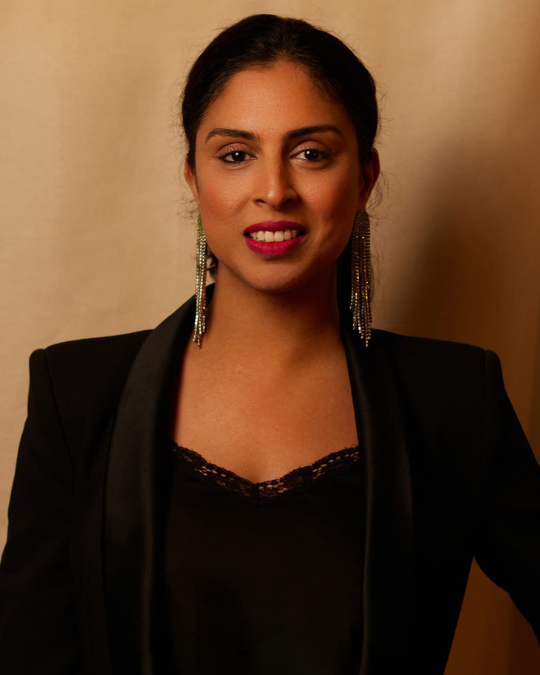
Anjeni Bedi
Executive Board Member, CM Payments B.V. (part of CM.com)
Raised with ambition and sensitivity
Anjeni grew up as the oldest of three daughters in a family made up entirely of women.
“It was really about feelings.
"About care. About connection."
At the same time, the bar was set high.
“Going to college and standing on my own two feet just seemed like the natural thing to do.”
That combination—gentleness and a drive to excel—still forms the foundation of who she is today.
It wasn't until later, when she herself became a mother of two, that she truly began to understand how much of her upbringing she had carried with her.
“As you get older and have children of your own, you start to reflect more and more. That’s when you realize just how much of your parents is still in you.”
She doesn't call it a strict upbringing. But she does call it an upbringing in which personal development wasn't an option.
“Doing your best was really the only option.”
The Boardroom as a Man's World
Today, Anjeni is an executive board member at CM Payments, a division of the publicly traded company CM.com. Drawing on her background in compliance, she focuses on integrity, governance, and regulation within the financial sector.
A world in which oversight, monitoring, and decision-making are central.
But it’s also a world where women are in the minority. Although that is starting to change.
“I’ve never really been aware of that,” she says. “Until someone points it out.”
Still, she sensed early on that there were unwritten rules.
“You automatically find yourself adapting.”
Not because someone explicitly asks for it. But because you understand what works in that kind of environment.
“Sometimes I had to rein in that empathetic side of myself. Because if you operate solely on emotion, it doesn’t work.”
And so something emerges that many women can relate to: the constant search for balance.
Between empathy and decisiveness. Between connection and results. Between femininity and being taken seriously.
Why Women's Leadership Is Needed
What Anjeni is seeing change is that organizations are slowly beginning to realize that traditional leadership is no longer enough.
“Companies often think in the short term. Quick results. Quick profits.”
But sustainable growth requires something else.
“Women tend to focus more on the long term. On connection. On what’s going on beneath the surface.”
According to her, there is an enormous power there that has been underestimated for years.
“You can see that women are quicker to make connections between people, teams, and departments.”
Don't dominate just for the sake of dominating. Instead, build, connect, and foster support.
And especially at a time when organizations are struggling with culture, change, and trust, these are no longer just “soft” qualities.
These are essential qualities.
Leadership Without Distance
For Anjeni, good leadership isn't about creating hierarchy. On the contrary.
“If people feel like you’re not approachable, you’ll never really get anything done.”
It is precisely in the field of compliance—an area often viewed as strict or controlling—that she considers human connection to be crucial.
“People need to feel comfortable approaching you.”
That means being visible. Being present. Communicating honestly.
Even when you don't have all the answers.
“Even if you don’t know something yet, you should be able to say so.”
According to her, trust isn't built through perfection, but through transparency.
The pressure women still feel
Still, she notices that women still move differently in professional settings.
“Women often tend to wait until they fully understand everything before they say anything.”
She recognizes that in herself, too.
“I had to figure everything out first before I said anything about it.”
She sees that pressure to be prepared, flawless, and thorough much more often in women than in men.
And that has consequences.
Because while women continue to second-guess themselves, others are indeed taking up space. At the same time, she is fortunately seeing a shift in society.
“There is a growing recognition that diversity in leadership is essential.”
Not just gender balance. But true diversity.
“In age, background, faith, and perspective.”
Because, according to her, the best conversations happen precisely when people don't think the same way.
Sisterhood as a Counterforce
What was barely visible in the past, she now sees emerging more and more clearly: women who consciously support one another.
“Sisterhood really makes a difference.”
During her college years and her first jobs, she actually saw things differently.
“Many women adopted masculine traits in order to be taken seriously.”
That was the norm.
“You thought: If I want to get ahead, I have to get tougher.”
Now she sees that women are increasingly daring to take up more space by drawing on their own strength—not in spite of their femininity, but precisely because of it.
And that makes a difference.
“Supporting one another has an impact on the status of women in general.”
Not just in businesses, but also in politics, government, and civic organizations.
Back to her roots
Her connection with Udaya came at a time when Anjeni herself was becoming increasingly preoccupied with her identity.
“I’m Hindustani and Hindu, but I’d never really consciously explored that part of myself.”
That changed gradually. Because of her marriage. Because of motherhood. Because of the question of what she wants to pass on to her children.
Her husband has Indian roots and is from the Sikh community.
“Then you start thinking. What do you pass on? What values? What kind of spirituality?”
She also realized how different her own childhood was compared to that of many other Hindustani families.
“We didn’t have a large community around us. No daily network of relatives or a close-knit Hindustani circle. My parents were the only family in Utrecht.”
It wasn't until later that she began to feel that something was missing.
A deeper connection to her roots. To her history. To the question of where she truly comes from.
Sri Lanka and Its Struggle with Itself
Anjeni recently traveled to Sri Lanka with her family. That trip had a greater impact on her than she had expected.
“That’s where I really started to reflect.”
Not just at work, but in her entire life. On personal growth. On dharma. On the question of what she truly needs.
“As professionals, we take far too little time to reflect on ourselves.”
According to her, we're constantly striving to perform, keep going, and deliver.
But rarely with the question: What do I actually need?
“There are plenty of coaching programs out there. But ultimately, you have to figure out for yourself what you truly want.”
And that’s exactly what she wants to bring to the Captain’s Dinner.
Not a perfect success story. But an honest story about never stopping learning. Never stopping the search. Never stopping growth.
How much space does a woman really get?
Perhaps the most poignant part of her story is about freedom.
On the question of how much room women are actually given to develop themselves.
“Within the Hindu community, I’m not sure if all families are ready for this yet.”
Not just professionally. But also emotionally and spiritually.
She herself was given that freedom, though.
“In our family, it was just a given that you invest in yourself.”
But she also knows that this isn't true for everyone.
Her own marriage differs from traditional expectations.
“My husband does a lot for the kids, and we share the household and caregiving responsibilities.”
And even that, she says, is still far from being accepted everywhere.
“I don’t know if the average Hindustani man is willing to do that.”
But she also makes it clear right away that this is not a problem unique to a particular culture.
“Dutch men often aren’t there yet, either. Because ultimately, the responsibility for caring for children, managing the household, and emotional labor still falls more often on women. If a child is sick, who takes care of them?”
The answer is usually the same.
“It’s still a work in progress everywhere.”
A community where everything can coexist
What ultimately attracts her to Udaya is its openness.
“Not everyone has to believe the same thing.”
Some seek deeper meaning through religion. Others through spirituality. Still others through personal development.
“And all of that can coexist here.”
To Anjeni, that feels rare. A place where depth matters more than appearances. Where identity isn't set in stone. Where growth is the focus.
“To me, it feels like a really great community.”
Be true to yourself
If her story has one central message, it is this: You don't have to lose yourself to be successful.
Not tougher. Not colder. Not less of a woman.
But actually, be more honest with yourself. Be more mindful.
And closer to who you really are.